
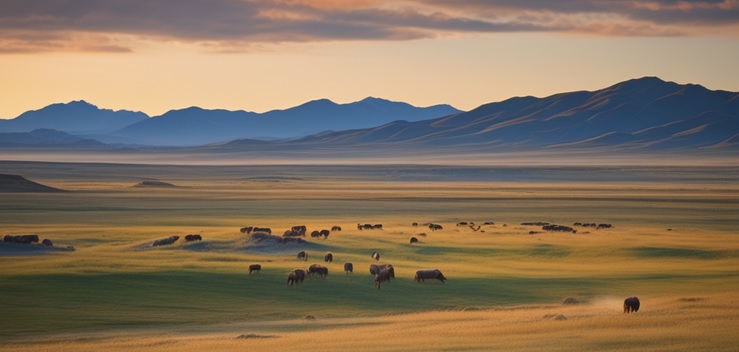
I am writing a long steppe story that happened in the 7th century in the area that was located between the Mongolian steppe, the Tibetan highland and the Taklamakan desert. It is one part romance, one part Kung Fu, one part history, in which I will embed a lot of arguments between the nomadic life and the agricultural lifestyle, between men and women, between radicals and negotiators. I don’t know if it will work, but it is certain that I will never know unless I try, isn’t it?
The reason I want to write a steppe story is because I have been struggling to write two immigrants’ stories, but they just don’t come out like what I want them to be. I don’t understand why. I have a lot of material to work with, but they just tend to be boring. I cannot find a style that can lift it out of its boredom. I am still searching for a better way of presenting it. Or probably it is hopeless to begin with.
Anyway, I’ve always liked historical stories and enjoyed books about tribes that came before Mongolians moved south from their Siberia grassland.
As you know, it is said there used to be more than 120 tribes roaming in the vast area from Altai mountain to the shore of the northern Pacific. At one time or another, one tribe would get stronger and eventually the tribe would establish a nomadic confederacy. They were Xiongnu and Xianbei before the 7th century. The Turkic Kaughanate came before and around the 7th century, after which Urghur Kaughanate came to power. After they moved to the northwest, Mongolian tribes filled the void, which eventually culminated in Genghis Khan in the 12th century.
For the current steppe story, it only concerns the 7th century. Zoa wants to establish a tribe led by a woman, and Wichi doesn’t like the idea. It starts with a siege and the struggle between different entities, which try to take advantage of the siege to achieve their own goals.
The second part of the story describes Zoa in Chang’an, the capital of Tang empire where Zoa struggles to make a living while Wichi struggles to stay away from Zoa’s life. However political intrigues abound. Zoa aligns with Empress Wu Zetian while Wichi groups with the rival political camp…
And here is the prologue I’ve written for the story.
Our story started in the mid-7th century, in an oasis town called Sand City, along the eastern stretch of the Silk Road, although people back then didn’t use the modern calendar to count time, and the phrase Silk Road would not be coined until more than a thousand years later. Here, the steppe and the desert suddenly gave way to a rippling lake and the attendant greenery, a mirage like town, owing to the melting snow from the Kunlun mountain range, stretching east and west for two thousand miles, which forms the northern edge of the Tibetan plateau.
Such a lake, deep and wide, clear and calm, amazed weary travelers after their arduous journey through miles after miles of forbidding landscapes. Caravans stopped to take a rest, nomads came for trade, faithful people stayed and prayed and made caves of murals and statues. Here varied cultures coexisted and clashed, loved and hated, depended on and complained of each other. Here three political entities — the Tibetan Empire, the Turkic Khaganate and the Tang Empire (shortened as Tibet, Turkic, and Tang respectively in our story) — rivaled for dominance.
In an attempt to create a real 7th century atmosphere, all of the dresses, food, drinks, city layouts, customs, wars are attempted as accurately as those in the history books. The story is populated with as many real historical figures, real historical events as possible, although a handful of characters and incidents have to be invented to push the plot forward. It is a retelling of a hectic historical period of prosperity, conflict, change and chaos from the point of view of two lovers: Zoa and Wichi. One wanted to reimagine her life; the other wanted a life as it was. Their ideas differed; their intentions varied, their conflicts arose, their love evolved…towards an eventual happy ending.
 Haoyan Do
Oh man! How can I describe the eagerness I feel about reading what comes next in the story? The only thing I can say: I am coming back for more!
LikeLiked by 1 person
Love it! Can’t wait to read the story
LikeLiked by 2 people
Thank you. I am in a forever writing and editing mode right now.
LikeLiked by 1 person
That is a very interesting start. As you know, I do enjoy reading stuff like this since I love history.
LikeLiked by 2 people
Me too. I love history despite the fact that there are very few women in it. LOL.
LikeLiked by 1 person
I took a lot of history classes revolving around women which I found a lot more interesting for me. Mainstream history is definitely mostly about men.
LikeLiked by 1 person
Lucky you. All the histories I ever learned are about men and rarely about women. Even now, with internet and everything, it is still not so easy to find information about a specific woman I want to know more. I didn’t even realize this until very late. How stupid of me.
LikeLiked by 1 person
In high school we rarely learnt about women in history but university was very different which I appreciated. Yes, it’s much harder to find the history of women because most of it wasn’t deemed important enough to record.
LikeLiked by 1 person
So true. And now I am trying to write women’s historical story. I don’t know why. I suddenly realize that I want to combine my interest in history and in women, and most of the stories have to be imagined since there is no record.
LikeLiked by 1 person
That’s my favourite genre but yeah I can imagine it’s very hard to write because you have to be historically accurate but also very imaginative.
LikeLike
They have been some cases where facial features have been reconstructed from skulls. I wonder if anybody has attempted that?
Can I ask what your first language is? Mongolian?
LikeLiked by 1 person
Haha, good idea. I think the most contentious issue is about the Ashina clan which is said to be the ruling family of the Turkic Khaganate. Some insist that the Ashina clan looks East Asian, while others don’t agree. So a DNA test was done on a sample from an ancient tomb. Anyway, I am half Chinese half Mongolian. Unfortunately I don’t know much Mongolian. My first language is Chinese. In this aspect, I’m like Asian Americans who don’t know much about Asia or Asian languages due to fact that their jobs and their environment are all in English. If I were to know Mongolian, it will be easy for me to learn Japanese since they are related languages, but life doesn’t always happen the way we like it.
LikeLike
I look forward to reading the rest of the story!
It’s interesting that you mention Turkic tribes. We are going to Turkey in September and, reading the travel guide, I was surprised to learn how far east Turkic people (and languages) extend.
LikeLiked by 1 person
There have been fierce debates on what people looked like in Turkic Khaganate (first, second, east, west, all four nomadic tribal confederations occupying areas from the Pacific coast to somewhere in between the Caspian Sea and the Altai mountain) from the 6th century to the 8th century. Some believe they looked like East Asian and some think they looked more like people in Central Asia. And DNA tests have been done from samples of ancient tombs. LOL. Curiously the known historical records never mentioned what category of facial features these Turkic tribes had. I guess ancient people were not as shallow as modern people. What is certain is that the Turkic Khaganate included a lot of proto-Mongolian tribes in their confederations.
LikeLiked by 1 person
May the words flow!
LikeLiked by 2 people
Prologue sounds very interesting. All the best!
LikeLiked by 1 person